
Let’s get one thing straight: Israel is tiny. It’s roughly the size of New Jersey, but with way more history per square inch and much better hummus. You could drive from its northern tip to the southern desert in about six hours, which is less time than you’ve probably spent scrolling through Netflix tonight. Yet this little sliver of land is arguably the most famous (and most argued-about) patch of earth on the planet.
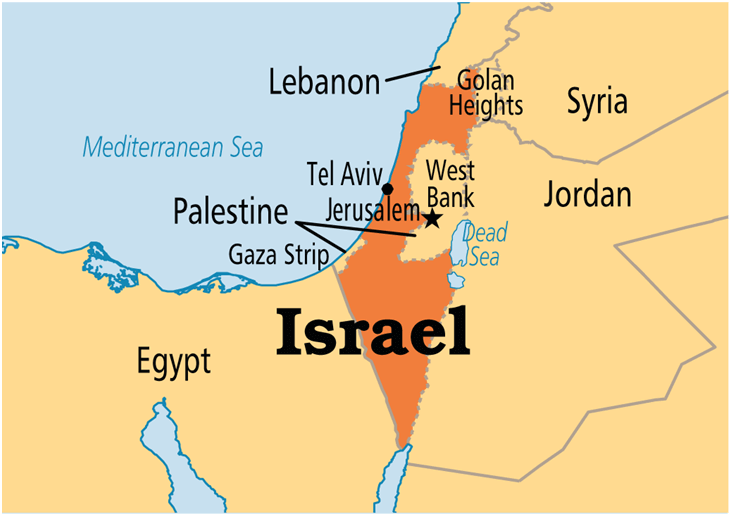
Geographically, Israel is stuck—in a good way—at the eastern edge of the Mediterranean Sea. Picture the map: it’s that narrow strip wedged between Lebanon and Syria to the north, Jordan to the east, Egypt to the southwest, and the Mediterranean to the west. If you’re looking for it on a globe, find the top of Africa, scootch over to the left side of Asia, and squint. You’ll see a little country that looks like a sideways dagger pointing south. That’s Israel.
Now, for the real star of the show: Jerusalem. Think of Israel as the body, and Jerusalem as its ancient, slightly chaotic, and deeply soulful heart. But here’s the kicker: Jerusalem isn’t even on the coast. While most countries put their capital on a beach, Israel decided to nestle its holiest city about 35 miles inland, up in the Judean Mountains. It’s like choosing to build your headquarters on the highest hill for a better view—and to make sure everyone sees you from miles away.
The "Where in the World Is Jerusalem?" Quickie
Jerusalem sits roughly on a line between the Mediterranean Sea (west) and the Dead Sea (east). You know, that sea so salty you can float in it while reading a newspaper? Yeah, that one. So close, yet so geologically weird. From Jerusalem, you can drive west and be splashing in the Mediterranean in under an hour, or drive east and float like a cork in the Dead Sea after twenty minutes.
The city itself is built on a series of hills. And I mean hills—the kind that make your calves burn if you forget to bring water. The elevation is about 2,500 feet above sea level. That might not sound like much, but it’s enough to give you a sweet view and, occasionally, a dusting of snow in winter. Yes, snow in Jerusalem. The city throws a massive, Instagram-worthy fit every time a single flake falls.
Why Everyone’s So Obsessed with This Little Spot
You can’t talk about Israel and Jerusalem without mentioning the elephant in the room: it’s sacred to three major religions. Jews, Christians, and Muslims all have a claim to this real estate, which is why your news feed is constantly on fire. The Western Wall? That’s the last surviving piece of the Second Jewish Temple. The Church of the Holy Sepulchre? Christianity’s holiest site. The Dome of the Rock? That golden dome you see on every postcard marks where Muslims believe the Prophet Muhammad ascended to heaven. They’re all within a ten-minute walk of each other. Talk about a neighborhood with drama.
 Bethlehem Israel Map Photos and Premium High Res Pictures - Getty Images
Here’s a surprising fact: Jerusalem is 4,000 years old. That’s older than the Roman Empire, older than the Pyramids of Giza (well, close), and old enough to have a customer service record that’s basically impossible to find. The city has been conquered, destroyed, rebuilt, and renamed so many times that historians need a flowchart to keep track. It’s like the ultimate urban survivor—with a serious identity crisis.
Playing "Where’s Waldo?" With Borders
If you try to find Israel’s exact borders on a modern map, you might run into a headache. The country’s boundaries are a mix of armistice lines, UN resolutions, and hard-fought treaties. In 1948, Israel declared independence on a sliver of land the UN had carved out. Then things got, well, messy. The Green Line (the pre-1967 border) is the most commonly agreed-upon line, but even that looks like a squiggly, indecisive doodle.
And what about Jerusalem? Its borders are even fuzzier. The city is divided into West Jerusalem (mostly Jewish, modern, and where the government buildings are) and East Jerusalem (mostly Palestinian, older, and includes the walled Old City). Most countries keep their embassies in Tel Aviv because they don’t want to officially say which part of Jerusalem belongs to whom. It’s like the world’s most awkward guest list.
 Монголын Газарзүйн Боловсролын Нийгэмлэг
But here’s the fun twist: Tel Aviv is not the capital. Everyone thinks it is because that’s where the embassies are. Nope. Israel insists Jerusalem is its “eternal and undivided capital.” Meanwhile, Palestinians claim East Jerusalem as their future capital. It’s a high-stakes game of “this rock is mine,” with billions of dollars and millions of souls on the line.
The Final Takeaway (With a Side of Falafel)
So, to recap: Israel is a New Jersey-sized country on the eastern Mediterranean, and Jerusalem is its hilltop, 4,000-year-old, three-religion, snow-in-winter capital that nobody can agree on. It’s a place where you can eat a falafel sandwich in a market that smells like spices and time, then walk ten minutes to a site where a prophet might have had a vision.
Is it confusing? Yes. Is it complicated? Absolutely. Is it worth visiting? Only if you like unforgettable history, incredible food, and the most geopolitically charged game of Monopoly the world has ever seen. Just bring comfortable shoes, a sense of humor, and maybe a map that updates every five years. You’ll need it.

