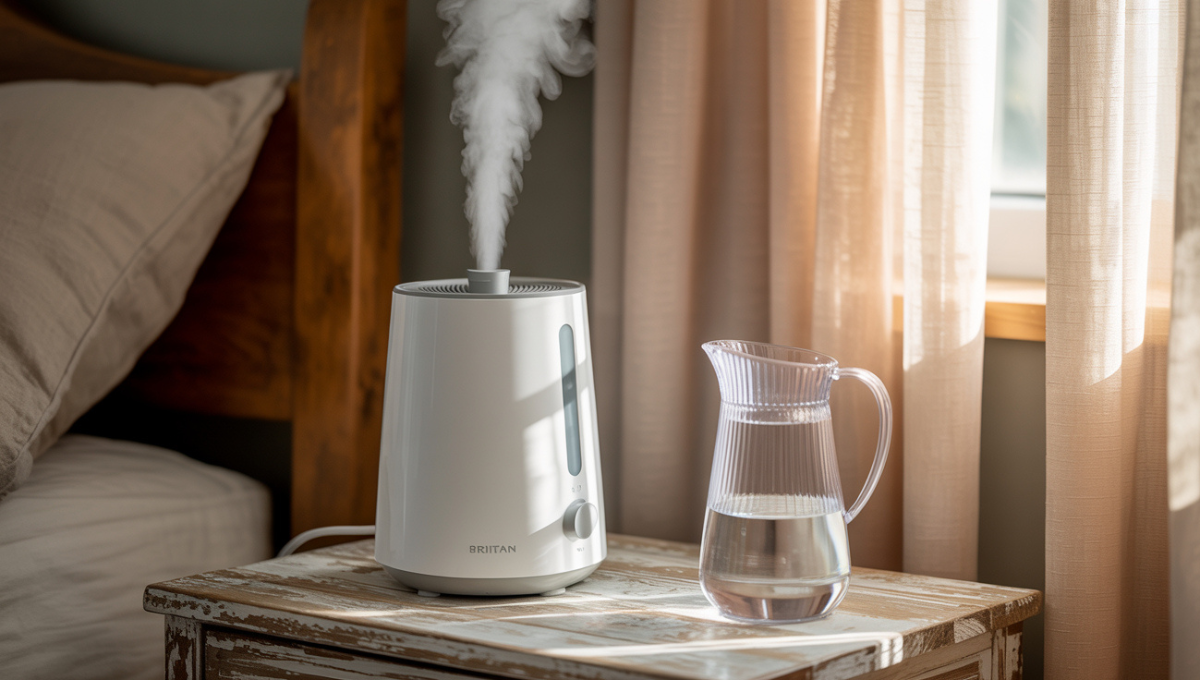
Your Brita filter is a champ at reducing chlorine, lead, and that weird metallic taste in your tap water. But here’s the thing: most Brita pitchers use activated carbon and ion-exchange resin, which do a solid job of reducing some minerals, but they don’t fully remove dissolved solids like calcium and magnesium.
Those same minerals, when vaporized in a humidifier, can leave behind that chalky white dust on your furniture—and even encourage bacterial growth if you’re not careful. Think of it like the mineral residue you see on a tea kettle after boiling hard water.
Still, Brita water is a massive upgrade from straight tap water, and for many people, it’s perfectly fine—especially if you live in an area with moderately hard water. Pro tip: Check your local water hardness report; if it’s below 100 ppm, Brita water is your humidifier’s best friend.
Real Talk: Brita vs. Distilled Water
Distilled water is the holy grail for humidifiers because it’s stripped of everything—minerals, bacteria, and all. It’s like the Marie Kondo of water: nothing left but pure H₂O. But let’s be honest—buying gallons of distilled water every week feels like a chore that belongs in the Mad Men era of household drudgery.
Brita water, on the other hand, is convenient, cheap (once you’ve bought the pitcher), and gives you about 70–80% of the benefits of distilled water without the awkward gym-bag-sized jugs. Fun fact: The average Brita filter removes about 60–70% of total dissolved solids over its lifetime. Not perfect, but pretty darn close for a plastic cool kid on your counter.
So, is it okay? For ultrasonic humidifiers (those whisper-quiet ones that look like minimalist space pods), you might still get some dust, but far less than with tap. For evaporative or steam humidifiers, Brita water is practically a godsend—they’re less picky about mineral content anyway.

