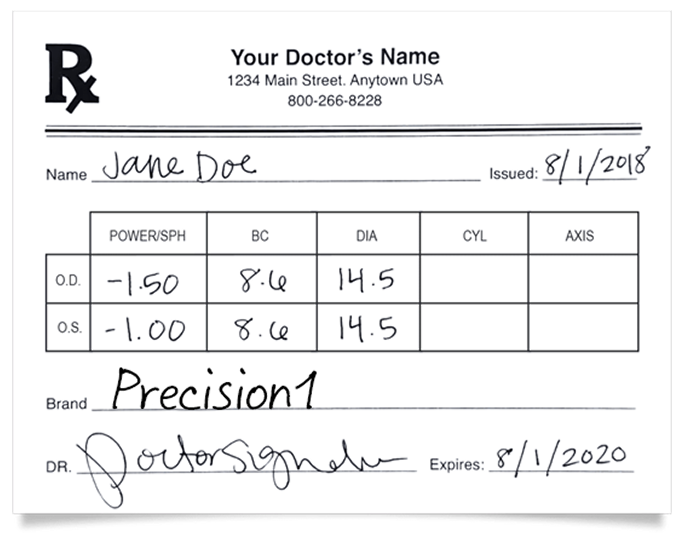
First up, you’ll see a series of numbers. The power (PWR) is the big boss—it’s the strength of the lens, measured in diopters. Think of it as the volume knob on your vision radio. A minus sign means you’re nearsighted (you can see your phone perfectly, but street signs look like a Seurat painting). A plus sign means you’re farsighted (great for spotting birds, but your book gets blurry after page two).
Then there’s the base curve (BC)—a number like 8.6 or 8.8. This is the curvature of your eyeball’s surface. If your eye were a bowling ball, the base curve is the gentle slope of the lane. Too flat, and the lens slides around like a wet bar of soap. Too steep, and it feels like a tiny alien has suction-cupped your iris.
The diameter (DIA) is another one—usually around 14.0 or 14.2. That’s the width of the lens. It’s like ordering the correct pizza size: too small, and you’re missing the toppings; too big, and it hangs over the plate and annoys everyone.
The cylinder and axis: the twisty drama part
If you have astigmatism, your prescription gets a little spicy. You’ll see a cylinder (CYL) number and an axis number. Cylinder measures the irregular shape of your cornea—imagine your eye is shaped like a rugby ball instead of a basketball. The axis (from 0 to 180 degrees) tells the optometrist exactly which way that rugby ball is tilted.
 WebEyeCare’s Guide on How to Get Contacts and a Prescription - WebEyeCare
I once joked to my eye doctor that my astigmatism axis was “45 degrees, because my eyes are professionally confused.” He did not laugh. But honestly, this part of the prescription is why many contact wearers have that one eye that occasionally feels like a dry cracker during a meeting. It’s fixable, but only if you dare to decipher the numbers.
And don’t ignore the brand name written at the top—like “Acuvue Oasys” or “Biofinity.” That’s not just marketing; those brands have specific curves and water content. Swapping them out is like putting a golf ball in a tennis match—technically round, but everyone gets confused.
The expiration date: the ultimate buzzkill
Your prescription has an expiration date, usually one or two years out. This is the universe’s way of telling you that eyes, like milk and gym memberships, change over time. I once tried to use a prescription that was three years old because I was lazy. The result? I walked into a glass door. True story. My forehead still gives me dirty looks.
 How to Read Your Contact Lens Prescription | PRECISION® US
Also, a contact lens prescription is not the same as a glasses prescription. Yes, they both fix your vision, but they’re like owning a bicycle and a unicycle—similar concept, wildly different balancing acts. Contacts sit directly on your eye, so the numbers are tweaked to account for the gap that glasses create. Never, ever use a glasses prescription to buy contacts online. That’s how you end up with a lens that feels like a frisbee and looks like a fishbowl.