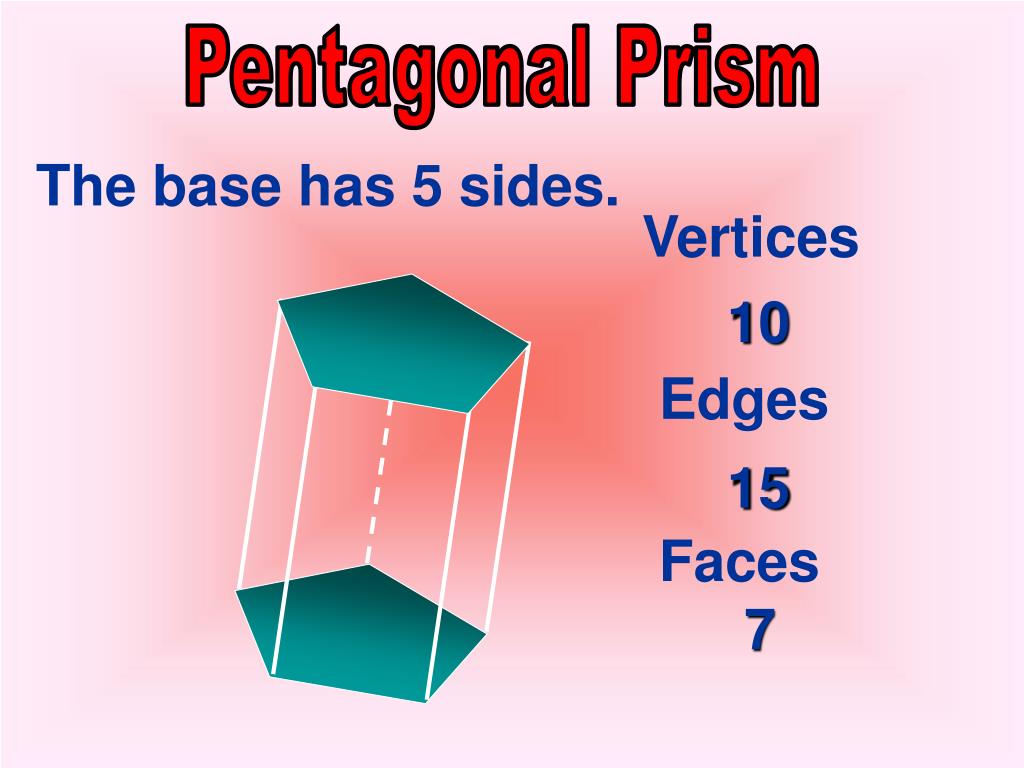
Start with a pentagon—that’s a five-sided shape, like the one on a soccer ball’s panel. Now, imagine pulling that pentagon straight up through the air, like you’re stretching taffy. What do you get? Two pentagons, one at the top and one at the bottom, both identical and parallel.
Connect those two pentagons with rectangles on every side, and bam—you’ve built a pentagonal prism. It’s like a can of soup, but instead of a circle, the lid and bottom are five-sided. (Don’t try to stack soup cans like that, though—you’ll get a weird tower.)
In the math world, this shape is a 3D solid with flat surfaces. Every flat surface is a face, every line where two faces meet is an edge, and every corner where edges meet is a vertex. Simple, right? But the numbers get juicy.
Let’s Count: The Faces (The Skin of the Shape)
First up: faces. Think of them as the “skin” or the panels of the prism. Our pentagonal prism has two pentagonal faces—one on top, one on bottom. That’s the easy part.
But wait—it also has five rectangular faces wrapping around the sides. Why five? Because a pentagon has five sides, so you need five rectangles to connect the top and bottom pentagons. Add it up: 2 pentagons + 5 rectangles = 7 faces total. (Take a second to count on your fingers—it’s oddly satisfying.)
So, a pentagonal prism has seven faces. That’s more than a cube (which has six), but less than, say, a dodecahedron (which is just showing off). It’s the Goldilocks of prisms—not too many, not too few.
+10+Edges+(lines)+15.jpg) Pentagonal Prism Faces Edges And Vertices
Pentagonal Prism Faces Edges And Vertices
Now, Edges: The Lines That Hold It Together
Move to edges—the lines where two faces meet. On the top pentagon, there are five edges. Same for the bottom pentagon: five more. That’s ten edges just from the pentagon parts.
Then, you have the vertical edges—the lines that connect each corner of the top pentagon to the corresponding corner on the bottom. A pentagon has five corners, so that’s five vertical edges. Add ‘em: 10 (from pentagons) + 5 (vertical) = 15 edges total.
Honestly, edges are where things get tricky. You might think there are more, but trust the math. Fifteen edges means this shape is sturdy—like a geometric tent that won’t collapse in a windstorm. (Unless you built it with toothpicks, in which case—good luck.)
Vertices: The Pointy Corners
Now for the vertices—the sharp corners where edges meet. A vertex is like a meeting point for three or more edges. In a pentagonal prism, every vertex is where three edges come together: two from the pentagon and one vertical edge.
Count the corners on the top pentagon: that’s five vertices. The bottom pentagon also has five vertices. No sneaky hidden corners here. So total vertices = 5 + 5 = 10 vertices.
Ten vertices, fifteen edges, seven faces. That’s the magic triplet for this shape. And guess what? It follows Euler’s formula: Faces + Vertices - Edges = 2. Plug it in: 7 + 10 - 15 = 2. It works! Euler would be proud—or at least mildly amused.
 Faces, Vertices and Edges in a Pentagonal Prism - Neurochispas