Imagine sodium (Na) as a hyperactive kid who really wants to give away his one toy. That toy is an electron.
Now picture chlorine (Cl) as a grumpy loner who needs exactly one more toy to feel complete. Perfect match.
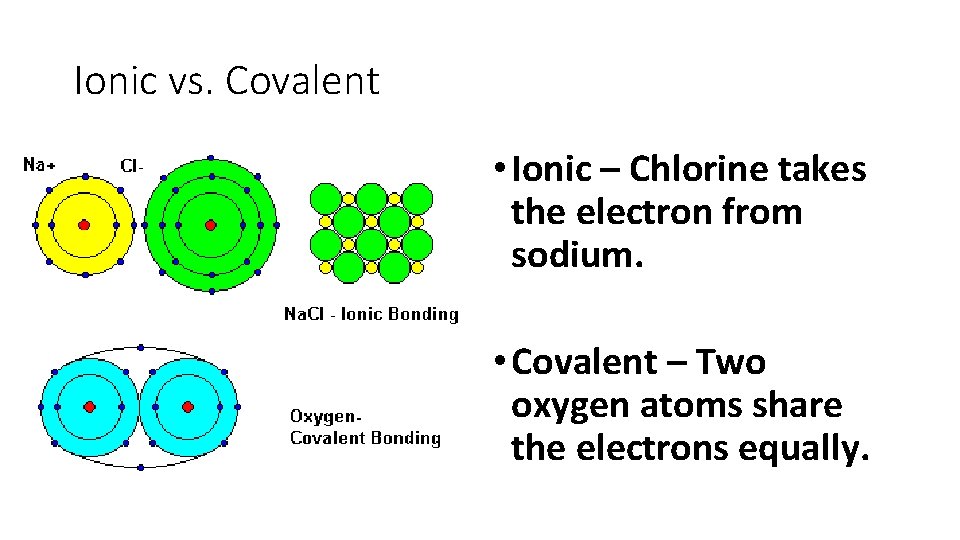
Sodium hands over its electron. Boom. They’re now ions—charged particles. Sodium becomes positive (Na⁺). Chlorine becomes negative (Cl⁻). Opposites attract.
That’s the ionic bond. It’s not sharing. It’s a total surrender of an electron.
Why This Matters at Dinner
You sprinkle salt on fries. The crystals dissolve instantly. Why? Because water is a polar molecule—it loves pulling charged ions apart.
If salt were covalent, it would be sugar. Sugar shares electrons. That’s why sugar dissolves slower and tastes different. Science tastes weird.
Ionic bonds = salty crunch. Covalent bonds = sweet melt. Your tongue already knew this. Your brain is just catching up.
Quirky Fact: Salt Isn’t Really “Molecules”
Here’s a mind-bender. Table salt doesn’t form discrete molecules like water (H₂O). It forms a crystal lattice.
Think of a giant 3D grid of sodium and chlorine ions, all holding hands. There’s no single “NaCl molecule.” It’s one enormous ionic network.
 Bonding Lab Bonding Discussion Bonding Ionic Covalent Metallic
When you crush salt, you’re just breaking that lattice into smaller chunks. Violent chemistry. And we eat it.
What Would Happen If Salt Were Covalent?
Let’s play what if. Imagine a covalent salt—a fake rock where sodium and chlorine share electrons.
It wouldn’t dissolve in water. It wouldn’t conduct electricity. It wouldn’t even taste salty. It would be more like plastic than salt.
Your French fries would be sad. Your pretzels would weep. Thank the chemistry gods for ionic bonds.