
Think of the coarse adjustment knob as the big, clumsy friend who moves furniture around. It shifts the stage—the flat bit where you put your slide—up or down in large, dramatic movements. This isn’t subtle work. It’s a bulldozer, not a surgeon’s scalpel.
You turn it, and BAM—the stage lurches toward the lens or away from it. That’s how you get your specimen roughly into view. Without it, you’d be hunting for a tiny flea in a dark, blurry ocean. Rhetorical question: Who has time for that?
It’s the lazy way to focus, but in a good way. You don’t want to fiddle with tiny adjustments when you’re still lost. You want to announce yourself to the slide. The coarse knob is basically yelling, “HEY, I’M LOOKING AT YOU!”
When Should You Use It? (And When to Run Away)
Use the coarse knob only with the low-power objective lens. That’s the shortest one, usually the 4x or 10x. Why? Because the lens is far away from the slide. So you can move things around without crashing them together. Crash being the key word.
Never—and I mean never—use the coarse knob with the high-power lens (the 40x or 100x oil one). If you do, you’ll drive the lens straight into the slide. It’s like trying to parallel park a monster truck in a compact spot. Disaster. You’ll crack the slide, scratch the lens, and possibly cry a little.
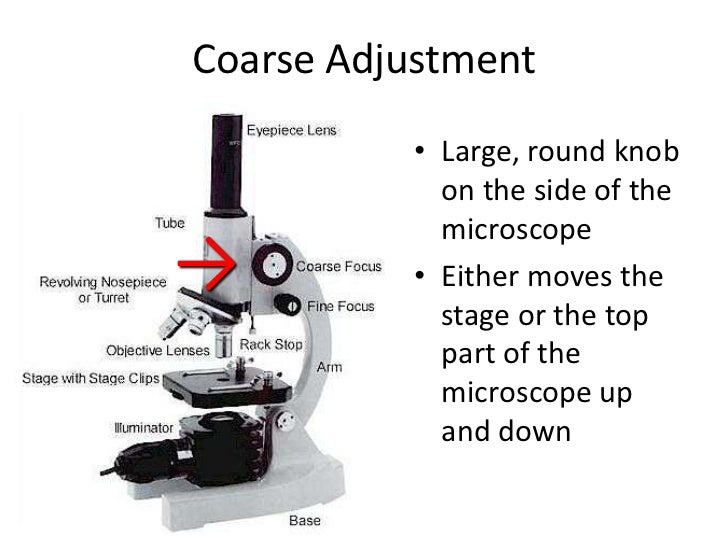 Parts of a microscope
So think of the coarse knob as your starter tool. You use it to get the image from “gross blobs” to “almost recognizable” once. Then you stop touching it. Seriously. Hands off.

