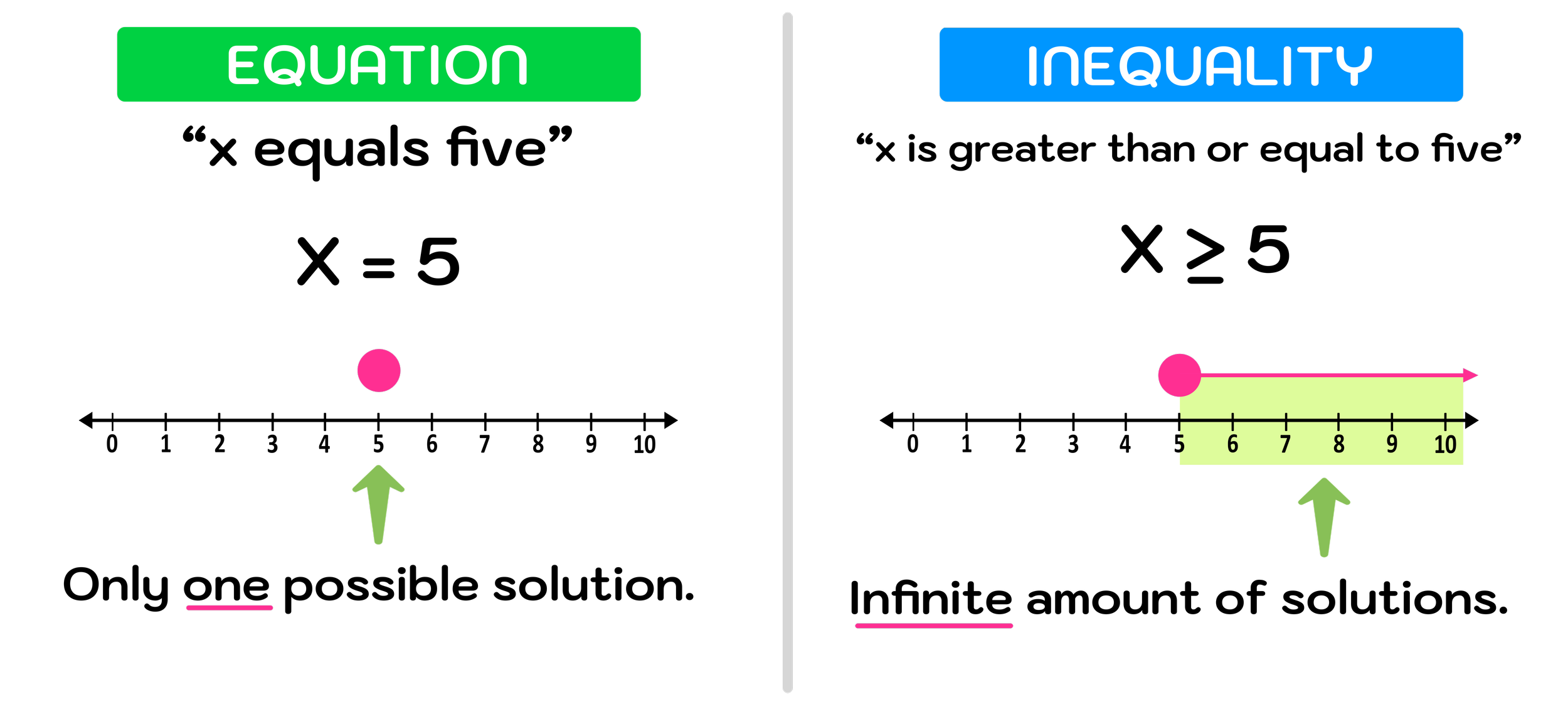
Now, flip the script and look at an inequality. Instead of an equals sign, you get <, >, ≤, or ≥. That little arrow is basically saying, “Hey, it’s not just one number—it’s a whole neighborhood of answers.”
Inequalities are for when life isn’t so black and white. If an equation is a bullseye, an inequality is a target zone. You just have to be in the area.
Think about it like this: an equation is like saying, “We must meet at 3:00 PM sharp.” An inequality is like, “Show up before 4:00 PM and we’re good.” Way more chill, right?
The Core Difference: One vs. Many
Here’s the simplest way to remember it: an equation gives you one value (or a few specific values). An inequality gives you a whole set of numbers that work.
Take x + 2 = 5. You solve it, and x is 3. That’s it. End of story.
 Difference between Equations & Inequalities (Important) | Math | ShowMe
Now take x + 2 > 5. All of a sudden, x can be 3.1, 4, 100, or 3,000. Any number bigger than 3 is fair game. It’s like the difference between a single address and an entire zip code.

