
An inference is like being a detective without a magnifying glass. You take what you see—the clues—and you make a logical guess about what’s happening right now.
For example, you walk into a room and see a pile of blankets on the couch, a half-eaten bag of chips, and the TV still on. You infer that someone was having a very lazy Saturday. You didn’t see that person, but the evidence is screaming at you.
It’s the difference between saying, “My friend is annoyed at me” (inference) and checking your phone to see a text that literally says, “I am annoyed at you” (fact). Inferences are the story we tell ourselves based on clues.
Predictions: The Game Show Host in Your Head
A prediction, on the other hand, is the loud friend who yells answers at the TV before the host asks the question. It’s about what hasn’t happened yet.
When you see dark clouds rolling in and you grab your umbrella, that’s a prediction. You are using past experience (rain + clouds = wet) to guess the future. You don’t know it will rain, but you’re betting your dry socks on it.
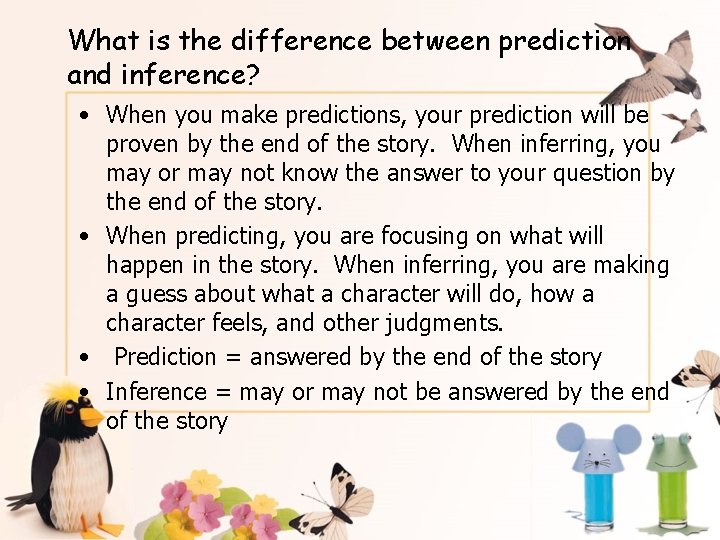 Prediction and Inference A Reading Strategy What is
Predictions are basically educated guesses with a side of hope. Like when you order a salad and predict you’ll feel healthy—three hours later you’re eating a donut. That’s not a failed prediction; that’s just life being rude.

