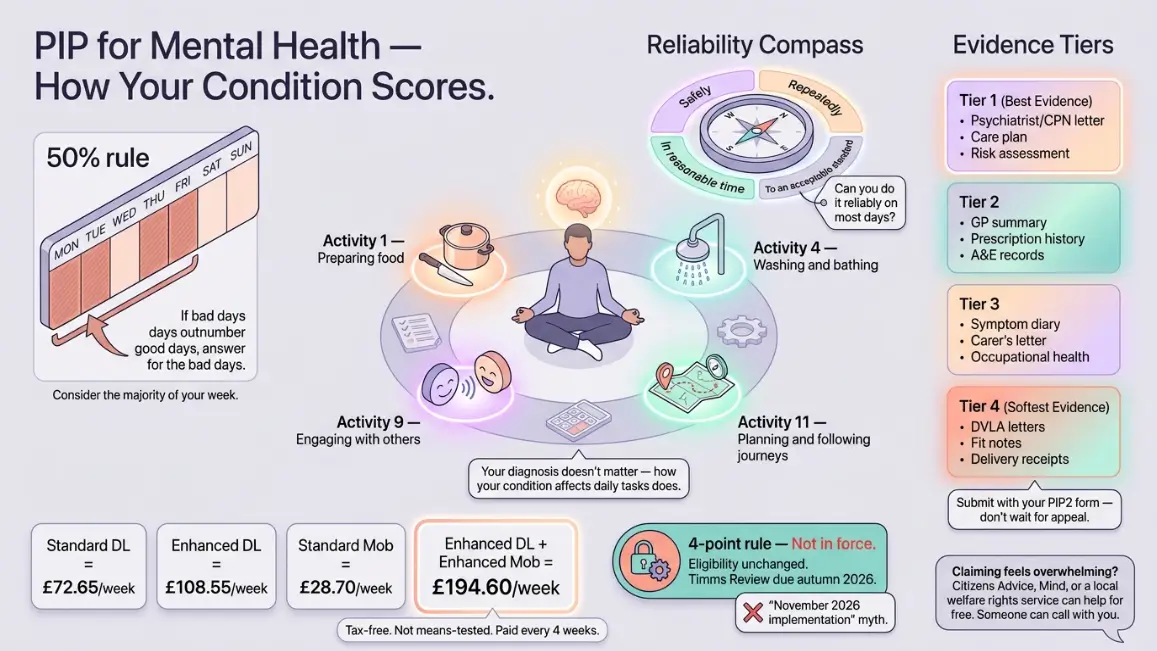
You get scored on things like: preparing food, washing, dressing, communicating, mixing with others. Each activity has descriptors like “needs prompting to undertake” or “cannot engage with people.” Every descriptor has a points value. You need to hit a certain number to qualify.
 PIP Rates for Mental Health: UK Payments Guide - briefingroom.uk
Here’s where it gets spicy: You don’t have to be a total wreck every single day. If you have “good days” and “bad days,” you describe the bad days. Or, more accurately, you describe what happens most of the time—over 50% of the time, to be specific.
So if you shower only twice a week because the sound of water makes you feel like you’re drowning, say that. Don’t be polite. Don’t minimize. The form is not your therapist—it’s a robot you have to convince.
What about mobility? (Yes, anxious walkers count.)
People assume PIP mobility is only for wheelchairs. Nope. If anxiety stops you from leaving the house alone, that’s a mobility issue. If you have panic attacks on the bus, that’s a mobility issue. If you can only walk your dog if someone is on the phone with you, yes, that counts.
Imagine telling the assessor: “I can physically walk to the shop. But my brain tells me everyone is staring, my heart races, and I end up hiding behind a bin.” That’s as real as a broken bone. Your internal experience is valid evidence.

