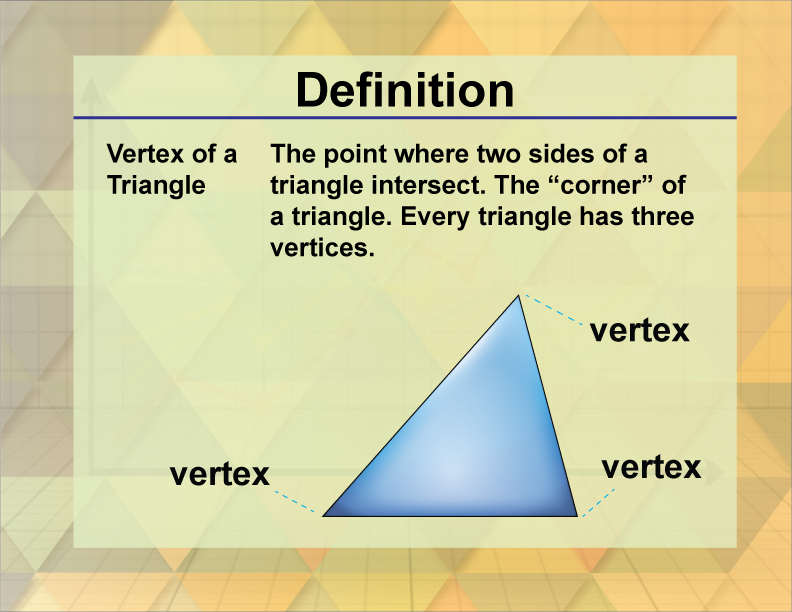
Look at a triangle. It has three vertices. They’re the sharp corners you can poke. A square? Four vertices. A pentagon? You guessed it—five.
But here’s a secret: not all vertices look the same. A cube has eight of them, but they’re 3D corners. In geometry-speak, we call those polyhedron vertices. Fancy, right? They’re just the corners of a dice or a Rubik’s cube.
 Vertex - Meaningful Math
Fun fact: A circle has no vertices. It’s just one long, continuous curve that refuses to make a sharp turn. A circle is the ultimate non-confrontational shape. No parties, no handshakes.
What About the Edges and Faces?
Okay, so the vertex is the point. The edge is the line connecting two vertices. And the face is the flat surface between edges. They’re like a family: vertices are the kids, edges are the paths they run on, and faces are the rooms they play in.
Here’s a mind-bender: if you count all the vertices of a cube, then subtract the number of edges and add the number of faces, you always get 2. It’s called Euler’s formula. I didn’t believe it either, but it works every time. Math is weird and wonderful.

