
How To Convert Whole Number To Percentage
Let’s be honest: math can sometimes feel like that one friend who shows up uninvited to a party. But converting a whole number to a percentage? That’s the friendly math you ac...
Let’s be honest: math can sometimes feel like that one friend who shows up uninvited to a party. But converting a whole number to a percentage? That’s the friendly math you actually want around. It’s like turning a simple dollar bill into a handful of shiny coins—same value, just way more useful for everyday life.
Think of the last time you saw a sale sign: “30% off everything!” Your brain didn’t just glow with joy—it immediately asked, “But how much will I actually pay?” That’s where converting whole numbers to percentages becomes your secret weapon. It helps you make sense of discounts, tips, and even your kid’s science test score.
So, what’s a percentage anyway? A percentage is simply a way of saying “out of 100.” When you say 50%, you mean 50 out of 100 pieces of pizza. When you say 100%, you mean the whole pizza—and no sharing!
Here’s the simple trick: take any whole number and divide it by the total you’re comparing it to. Then multiply that answer by 100. That’s it. You’ve just turned a number into a percentage.
Imagine you baked 12 cookies. You ate 3. What percentage of the cookies did you eat? First, divide 3 by 12: that’s 0.25. Then multiply 0.25 by 100, and boom—you ate 25% of the batch. You’re a cookie mathematician now.
Let’s try a real-world example. You’re at a restaurant and the bill is $40. You want to leave a 15% tip. First, turn 15% into a decimal by dividing 15 by 100 (that’s 0.15). Then multiply 0.15 by 40. Your tip is $6. That’s the same math, just reversed—and it’s the difference between a happy server and an awkward “I’ll figure it out later.”
Now, what if you want to convert a whole number like 75 into a percentage? Remember: a percentage always needs a “total” to compare against. Saying “75%” only makes sense if you mean “75 out of 100.” If you’re working with a total that’s not 100, you still use the same divide-and-multiply trick.
Suppose you scored 18 out of 20 on a quiz. Divide 18 by 20 to get 0.9. Multiply by 100, and you’ve got 90%. That’s an A in most teachers’ books, and you can brag about it without sounding like a math wizard.
Why does this matter? Because percentages are the universal language of everyday fairness. They let you compare things that aren’t obviously equal. A “25% off” sign is clearer than “Save $10”—because you don’t know if $10 is a big deal or a crumb.
Percentages also help you win at life’s little games. Your phone battery shows 68%—that’s your charge out of 100. Your bank app says you’ve used 40% of your data this month. You can predict when you’ll run out. That’s power, my friend.
Here’s a fun way to practice: next time you’re watching a basketball game, look at the free-throw percentage. That’s a player’s made shots out of total attempts, turned into a percentage. When a player hits 85%, you know they’re clutch—not just lucky.
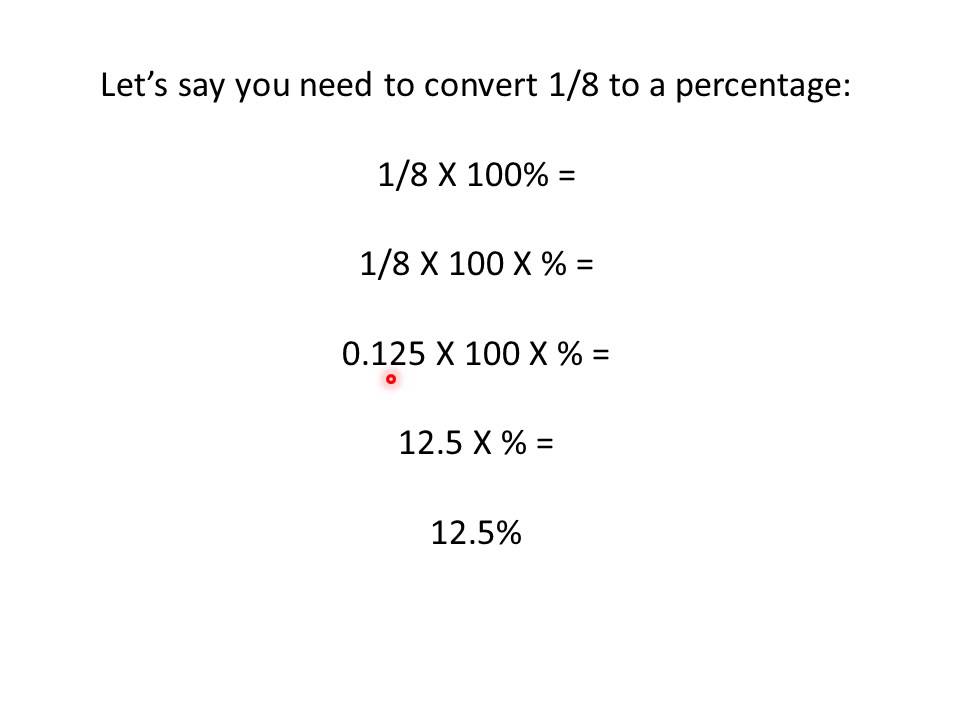 How to convert a number to a percentage - YouTube
I once had a neighbor who thought converting numbers to percentages was “math for math people.” Then she used it to figure out how much of her garden was tomatoes versus cucumbers. She planted 10 plants total, and 4 were tomatoes. That’s 40% tomatoes. She laughed and said, “Now I know why I’m tired of making salsa.”
Another trick: if you have a whole number like 100 and you want to write it as a percentage, just put % next to it. 100% is the whole thing. But if you have a number like 1, that’s 1% of 100. Feeling fancy? 1.5 is 150%—which means you have more than the whole, like one and a half pizzas.
Don’t let percentages intimidate you. They’re just friendly decimals with hats on. And you already use them without thinking: “I’m 100% sure I left my keys in the car.” That’s a whole-number percentage in its natural habitat.
So next time a friend asks, “What percentage of the movie have we watched?” You can answer confidently. You know the runtime is 120 minutes, you’ve seen 30 minutes, so 30 divided by 120 is 0.25, times 100 is 25%. Now you can decide if you want to stay or leave.
Remember: converting a whole number to a percentage is just about context. You always need a total. Without a total, a percentage is like a joke without a punchline—just a number standing alone, waiting for meaning.
Start small. Tomorrow, notice the nutrition label on your cereal. It says “18g of sugar” per serving. The total daily value is 50g. That’s 18 divided by 50, equals 0.36, times 100—36% of your sugar intake before lunch. Maybe grab a different box?
Here’s the best part: you don’t need a calculator for this. Your phone has one, but your brain is faster once you practice. Just remember the three-step dance: divide, multiply, add a % sign. It’s like a tiny victory dance for your intelligence.
I promise, once you start seeing percentages everywhere, you’ll feel like you’re wearing special glasses. The world becomes more transparent. You’ll know exactly how much of your savings you’ve spent, how much of your day is left, and how much of that pizza you really ate. (Hint: it was more than 50%.)
So go ahead. Convert something today. Your grades, your gas tank, your Netflix progress bar. It’s not math homework—it’s life literacy. And now you’re fluent.

