
Where Do Hurricanes Happen In The World
Let’s talk about nature’s biggest, angriest blender: the hurricane. These spinning monstrosities are basically Earth’s way of throwing a tantrum. But they don’t just pop up an...
Let’s talk about nature’s biggest, angriest blender: the hurricane. These spinning monstrosities are basically Earth’s way of throwing a tantrum. But they don’t just pop up anywhere. They have a very specific address—and it’s all about warm, wet water.
Hurricanes are picky. They need ocean water that’s at least 80°F (27°C) to get their spin on. You won’t find them churning in the frigid Arctic or the cold Atlantic off Canada. No, they are tropical beasts through and through.
Think of the planet like a giant belt. Hurricanes live between the equator and 30 degrees latitude. This zone is their playground. It’s warm, it’s muggy, and it’s perfect for chaos.
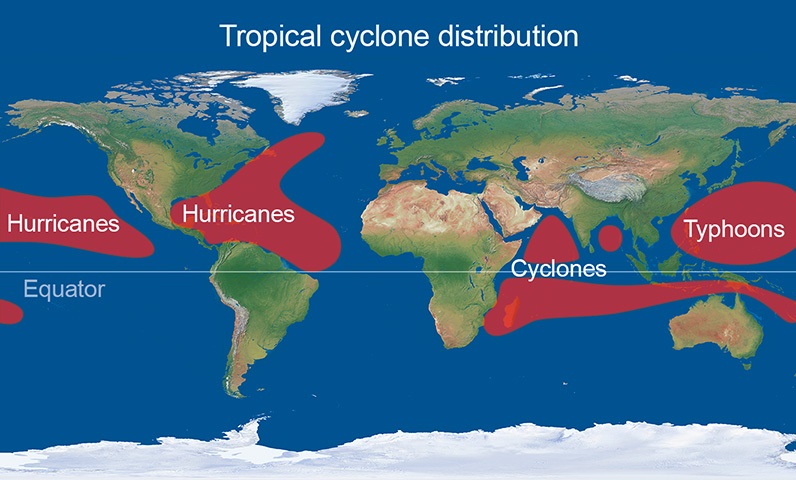
So, where exactly should you stick a pin in a globe to find a storm? The Atlantic Ocean is the most famous spot. Hurricanes here start near Africa, then ride the trade winds toward the Caribbean, the Gulf of Mexico, and the US East Coast. It’s a wild, wet road trip.
But the Atlantic is just one neighborhood. The Pacific Ocean is actually the busiest hurricane highway on Earth. The area near Mexico and Central America gets pummeled all the time. These storms hit places like Acapulco or Hawaii—and yes, Hawaii gets them too.
Hold up—did you know Japan gets hurricanes? They call them typhoons, but they’re the same thing. The Pacific Northwest Pacific, near the Philippines and Japan, is a hurricane factory. It’s like the storm is just a commuter with a badge.
Australia isn’t left out. In the Southern Hemisphere, they get cyclones (same storm, new name). These babies spin clockwise down there, not counterclockwise. Mind blown yet? They hit the coast near Queensland and Darwin, and people just call them “cyclones” like it’s no big deal.
What about the Indian Ocean? Oh, it’s a hotspot. Cyclones lash India, Bangladesh, and the east coast of Africa. Bangladesh gets hit especially hard because of its low-lying coast. It’s a scary place to be a house.
Here’s a quirky fact: hurricanes cannot cross the equator. Ever. The Coriolis effect (fancy science) makes them spin one way in the north and the opposite way in the south. They bounce off the equator like a pinball bumper. Weird, right?
Another funny detail: hurricanes hate land. They’re like vampires—they need water to survive. The moment they hit land, they start to die. But oh, the damage they do while kicking and screaming is legendary.
So where don’t they happen? Europe is basically a hurricane-free zone. The water there is too cold. A storm called Ophelia in 2017 made it close to Ireland, but it was a zombie hurricane—weak and dying. Europe just laughs at hurricanes.
 Different Types Of Hurricanes
What about the South Atlantic? It’s the only ocean basin where hurricanes almost never form. It’s too cold, and the wind shear (like a bully) tears them apart. One rogue storm, Cyclone Catarina, hit Brazil in 2004 and shocked everyone. It’s a one-hit-wonder.
Here’s a wild reality check: the planet has a set “season” for these storms. In the Atlantic, it’s June 1 to November 30. In the Pacific, it’s year-round, but peaks in summer. It’s like hurricane school is always in session somewhere.
But wait—climate change is moving the goalposts. Scientists say hurricanes are starting to form in places they never used to. Warmer waters mean storms can creep closer to the poles. Imagine a hurricane hitting London or Oslo. That’s a nightmare sci-fi plot.
Why is this fun to talk about? Because hurricanes are nature’s frenemies. They’re terrifying, but they’re also beautiful from space. They look like swirling cotton candy made of doom. And they remind us that Earth is alive and kicking.
So next time you see a weather map, look at the tropics. That sliver of ocean between the equator and 30 degrees is a stormy secret society. Hurricanes have their favorite hangouts—and they’re loud, wet parties.
Oh, and one last quirk: a hurricane’s eye is totally calm. Birds get trapped inside it, flying in circles until the storm passes. Imagine being a seagull on a carousel you can’t get off. That’s a wild commute.
Whether you call them hurricanes, typhoons, or cyclones, they all love the same thing: warm water and a little bit of spin. They are Earth’s biggest, messiest mixers. And they only party in the hottest neighborhoods.
So, pack your curiosity next time you hear about a storm. Ask yourself: “Where’s the warm water?” That’s where the party is. Just don’t bring your umbrella—it’s useless against 150 mph winds.

