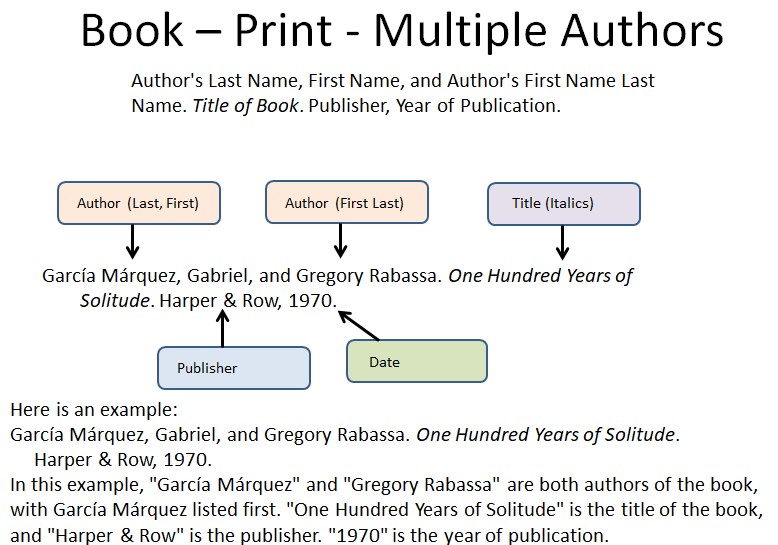
When you have two authors, your in-text citation looks like this: (Smith and Jones 42). Notice the “and” is spelled out, not an ampersand (&). On your Works Cited page, invert the first author’s name, but keep the second author’s name in normal order: Smith, John, and Emily Jones. Then add the book’s title in italics, publisher, and year.
A fun little fact: MLA used to require “and” only for two authors, but for three or more, you’d list all three. That changed in the 8th edition to save you space and sanity. Now, for three or more authors, you can use the shortcut “et al.”—which is Latin for “and others.” It’s like saying “the whole crew” without naming everyone.
Pro tip: If your instructor or publication requires all names, list them all like so: Smith, John, Emily Jones, and Michael Brown. But for everyday use, “et al.” is your friend. Check your syllabus—some professors love the full list, others don’t mind the shorthand.
Formatting the Works Cited Entry
Let’s build one together. Imagine a book by Jane Austen, Maya Angelou, and Chimamanda Ngozi Adichie (a dream team, right?). Your entry would be: Austen, Jane, et al. Then the title of the book in italics, the publisher, and the year. Simple as that—no extra commas, no panic.
Here’s a real-world example: Grazer, Brian, and Charles Fishman. A Curious Mind: The Secret to a Bigger Life. Simon & Schuster, 2015. Notice how the second author’s name is written normally? That’s Chicago Manual style territory, but MLA keeps it smooth. You don’t invert the second name—only the first.
Still scratching your head? Think of it like introducing a duo: “I’d like you to meet Smith, John, and Jane Doe.” The first name gets flipped, the second stays as is. It’s a tiny quirk that makes the list alphabetically tidy.