
This isn’t about grammar school. It’s about power. When you master where the question mark goes, you control the flow of a conversation. It’s like being a conductor for tiny ink symbols.
Pick a random book. Flip to a page. Notice every question mark near a quote. Is it inside? Outside? You’ll see patterns. American books are crowded. British books are sparse. It’s a visual game.
Try it while watching TV. Subtitles are terrible at this. They often put question marks outside when they shouldn’t. You can yell at the screen. “That’s not inside, you cowards!” It’s highly satisfying.
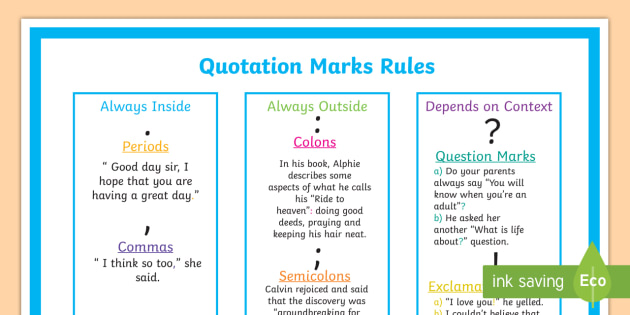 Quotation Marks Poster (Teacher-Made)
The Secret Trick for Writers
If you’re ever stuck, ask yourself this: Is the quote itself a question? Yes? Inside. Is the quote just a word or phrase? No? Then the question mark goes outside. This rule solves 90% of fights.
The other 10%? That’s the fun zone. Like when you quote a sign that says “Free Cake?” with a question mark. You write: The sign said “Free Cake?” That’s inside. But if you’re skeptical, you write: Did the sign really say “Free Cake”? Now you’re a punctuation wizard.
Remember: These are just marks on a page. But they decide who gets the last word. The question mark is the loudest. And where you put it tells the world if you’re polite or chaotic.

