Imagine trying to describe a single grain of salt in a swimming pool. You can’t say “a pinch” because that’s too vague. Ppm is the solution—a super-precise way to talk about very tiny concentrations without pulling your hair out.
It’s like the metric system for invisibility. For every million units of water (by weight or volume), you’re counting just one unit of the thing you care about. That could be calcium, chlorine, or even gold—yes, some water has trace gold!
Why “million”? Because most stuff in water is so dilute that percentages (like 0.001%) feel clumsy. Ppm makes the numbers human-friendly—1 ppm is the same as 0.0001%.
What Ppm Actually Tells You About Your Water
Ever had water that tasted a little chalky? That’s total dissolved solids (TDS), measured in ppm. A reading under 50 ppm is like distilled water—pretty bland. Between 150 and 400 ppm? That’s where most tap water lands, with a nice mineral zing.
But here’s where it gets wild: ppm can also spoil the party. If chlorine in your tap water hits 4 ppm, it’s safe to drink, but above that? You’ll probably taste a swimming pool smell. And lead? Anything over 15 ppb (parts per billion, which is ppm divided by 1,000) is a red flag.
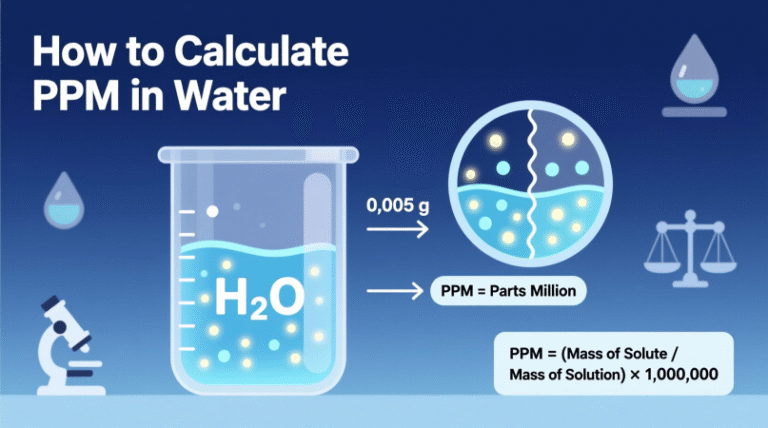 How To Calculate PPM In Water
So ppm isn’t just a number—it’s a safety score and a taste report rolled into one.